DECODING GTM CADENCE
Collaboration across GTM and finding the rhythm that works for you

I’d say that a top challenge for any GTM team is when they spend too much time on internal meetings.

But collaboration is critical to the success of any GTM organization. Sales teams need to collaborate among themselves, but the teams need to also collaborate across GTM and with leadership. Without seamless partnership, the sales process falters.
An operating cadence (or operating rhythm) solidifies how teams collaborate. It allows companies to understand past performance against an operating plan, but also builds alignment on the insights and actions to propel a business forward. The cadence needs to drive priorities and identify opportunities (and threats).
RevOps can help establish a culture of collaboration through an effective cadence. They should strike that balance for each role to provide consistent and proactive direction via the cadence while not drowning them team in meetings. Go as far as mapping out how much time for each role.
Here is a view of an effective cadence I’ve seen work. As with any good meeting practice, having a clear purpose is essential. My recommendation is always to start simpler and progress with more areas of focus over time.
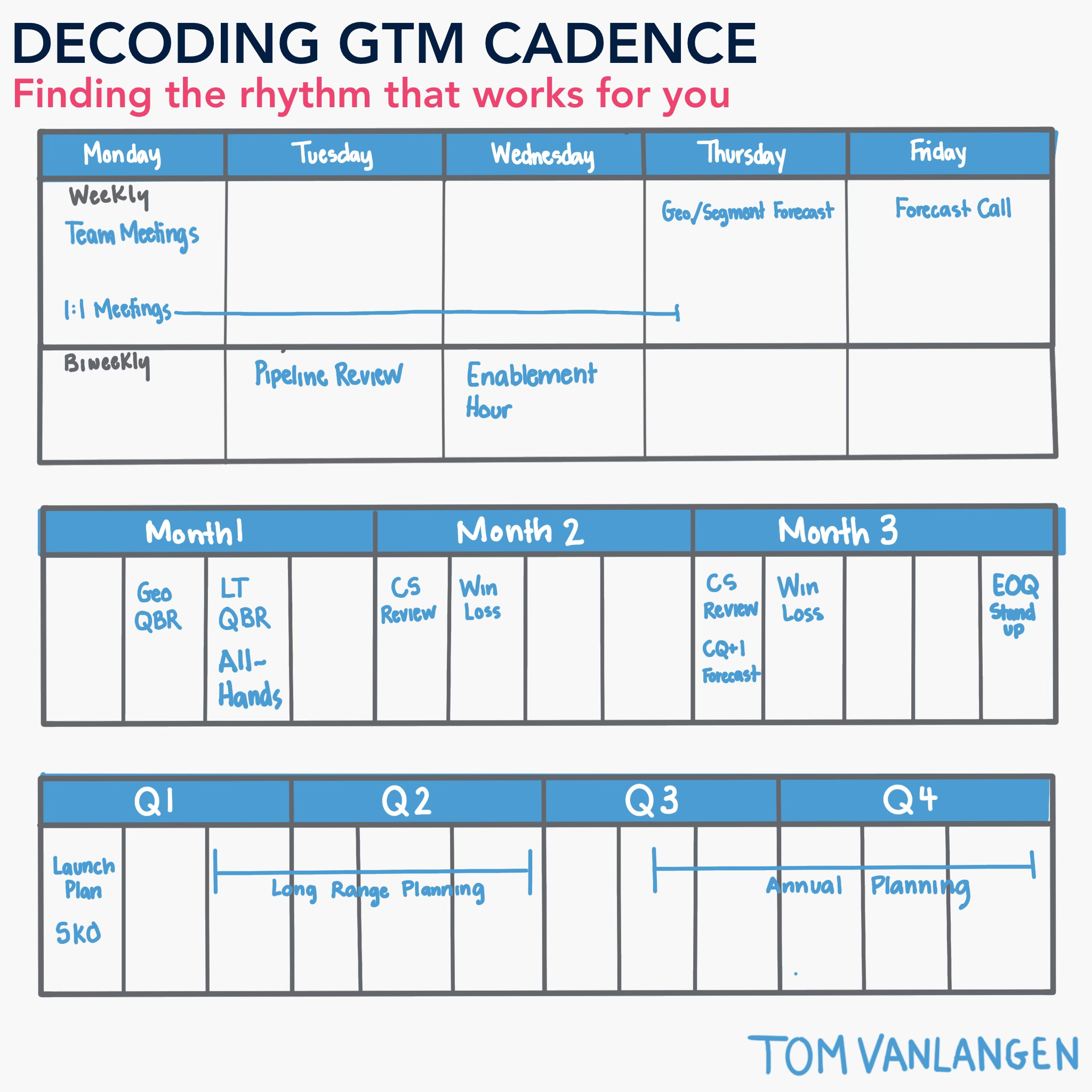
Quarterly Business Review (QBR). Business performance review and address what’s working, what’s not working well, what’s been learned, and strategies for the upcoming quarter.
LT QBR. Same as the above, but with your GTM Leadership team or C-Suite. Review key initiatives or special topics.
Team Meeting. Set the direction for the team and build towards common goals. Share company updates and prioritize (and deprioritize) initiatives.
Manager <> Rep 1:1s.
Review in-flight / committed deals. Pressure test what deals are in commit as well as best and worst cases. Avoid reporting the news.
Review prospecting / strategic account penetration. If pipeline is king, never let prospecting slip. Look at activity metrics as leading indicators but judge on outcomes.
Coaching and employee well-being.
Pipeline Review. Meet with all of the contributors to demand, namely marketing, channel, sales, enablement, and operations teams, to review the state and trend of the pipeline in relation to the business goals
Enablement Hour. Dedicated time for product marketing, marketing, and operations to share all the good things coming to GTM and enablement to train on critical topics.
Forecast. Triangulate the data points available to the business to provide a forecast of the expected business land.
End of Quarter Stand Up. Focus on next steps on top deals closing this quarter. Rapid team alignment and action to ensure you land the forecast.
CQ+1 Forecast. First look at the forecast for an upcoming quarter.
Win Loss. Examine and learn from key wins and losses to improve product, marketing, and sales processes.
Customer Success Review. Overall view of customer health and top initiatives to improve customer success. While current quarter renewals will be reviewed in the Forecast meetings, use this as an opportunity to discuss at risk customers that are further out and get well plans need to be actioned.
The business size (employees), focus (segment), and maturity can influence a cadence dramatically. The key is always tailoring for your own business needs.
My pro tips.
Give your Ops and Finance team a small break and do not schedule a QBR the first couple of days of a quarter. You need time to close the books.
Always treat the 1st month in a quarter differently. Skip the monthly meeting cycle. You will tend to cover some of those same themes in QBRs. It reduces some of that meeting strain.
Also, avoid scheduling meetings for the end of the month because they will start to interfere with the end quarter.
Circulate talking points the last weeks of a quarter. It’s very helpful to start to gain insights in to the performance an create a clearer narrative before QBRs.
A culture of collaboration fosters openness, transparency, communication and teamwork. When done right, an effective cadence creates an environment where employees feel safe to voice their opinions and share ideas… a key hallmark for a high-performing team.